Reverence for
Life |
|
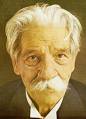
The following words by Albert Schweitzer are excerpted from Chapter 26 of The Philosophy of Civilization and from The Ethics of Reverence for Life in the 1936 winter issue of Christendom. I am life which wills to live, in the midst of life which wills to live. As in my own will-to-live there is a longing for wider life and pleasure, with dread of annihilation and pain; so is it also in the will-to-live all around me, whether it can express itself before me or remains dumb. The will-to-live is everywhere present, even as in me. If I am a thinking being, I must regard life other than my own with equal reverence, for I shall know that it longs for fullness and development as deeply as I do myself. Therefore, I see that evil is what annihilates, hampers, or hinders life. And this holds true whether I regard it physically or spiritually. Goodness, by the same token, is the saving or helping of life, the enabling of whatever life I can to attain its highest development. In me the will-to-live has come to know about other wills-to-live. There is in it a yearning to arrive at unity with itself, to become universal. I can do nothing but hold to the fact that the will-to-live in me manifests itself as will-to-live which desires to become one with other will-to-live. Ethics consist in my experiencing the compulsion to show to all will-to-live the same reverence as I do my own. A man is truly ethical only when he obeys the compulsion to help all life which he is able to assist, and shrinks from injuring anything that lives. If I save an insect from a puddle, life has devoted itself to life, and the division of life against itself has ended. Whenever my life devotes itself in any way to life, my finite will-to-live experiences union with the infinite will in which all life is one. An absolute ethic calls for the creating of perfection in this life. It cannot be completely achieved; but that fact does not really matter. In this sense reverence for life is an absolute ethic. It makes only the maintenance and promotion of life rank as good. All destruction of and injury to life, under whatever circumstances, it condemns as evil. True, in practice we are forced to choose. At times we have to decide arbitrarily which forms of life, and even which particular individuals, we shall save, and which we shall destroy. But the principle of reverence for life is nonetheless universal and absolute. Such an ethic does not abolish for man all ethical conflicts but compels him to decide for himself in each case how far he can remain ethical and how far he must submit himself to the necessity for destruction of and injury to life. No one can decide for him at what point, on each occasion, lies the extreme limit of possibility for his persistence in the preservation and furtherance of life. He alone has to judge this issue, by letting himself be guided by a feeling of the highest possible responsibility towards other life. We must never let ourselves become blunted. We are living in truth, when we experience these conflicts more profoundly. Whenever I injure life of any sort, I must be quite clear whether it is necessary. Beyond the unavoidable, I must never go, not even with what seems insignificant. The farmer, who has mown down a thousand flowers in his meadow as fodder for his cows, must be careful on his way home not to strike off in wanton pastime the head of a single flower by the roadside, for he thereby commits a wrong against life without being under the pressure of necessity. To learn about Albert Schweitzer in our "Worthy Lives Gallery", please click here. Reprinted from the Association Internationale Albert Schweitzer |